Who Is Disability Technology Being Built With?
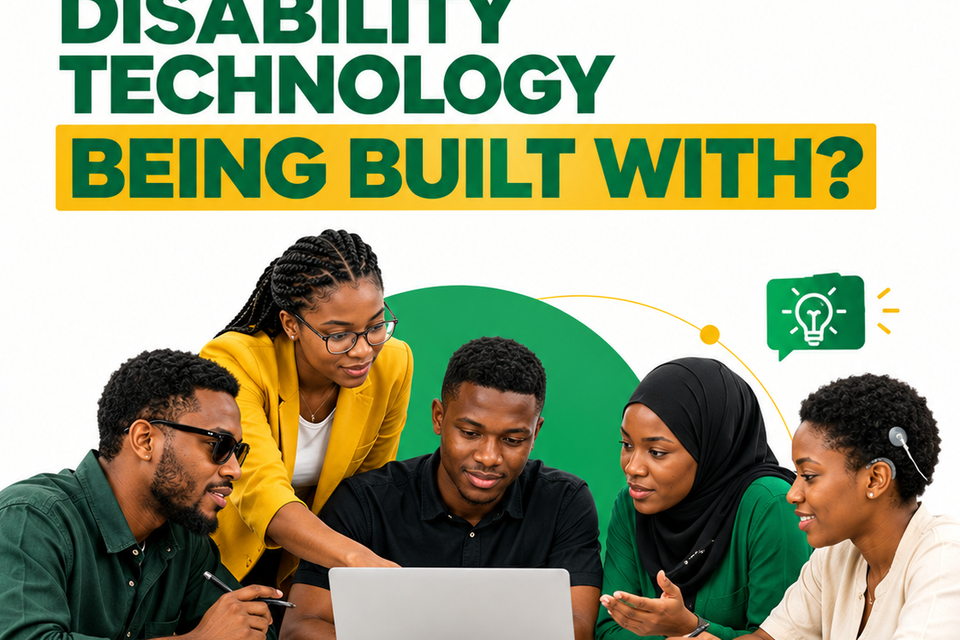
Who Is Disability Technology Being Built With?
Technology is often celebrated for its ability to solve problems, remove barriers and create new opportunities. Across the world, innovators are developing assistive devices, accessible digital platforms, communication tools and other technologies intended to improve the lives of persons with disabilities.
But there is an important question we do not ask often enough: Who is disability technology being built with?
Are persons with disabilities actively involved in identifying the problems these technologies address, shaping their design, testing their effectiveness and deciding what successful solutions should look like? Or are decisions being made about their lives without giving them a meaningful role in the process?
The answer matters because technology can be innovative and still fail the people it was created to support.
Building for People Is Not the Same as Building With Them
There is a difference between designing technology for persons with disabilities and designing it with them.
Building for people may begin with good intentions. A developer identifies a challenge, researches possible solutions, builds a product and eventually presents it to the intended users. However, without meaningful involvement from those users, the developer may misunderstand the problem, overlook everyday barriers or create a solution that is difficult to use in real-life situations.
Building with people takes a different approach. It recognises persons with disabilities as contributors whose knowledge, experiences and preferences should influence decisions from the beginning.
Consider an educational application designed for learners with disabilities. Its developers might focus on attractive interfaces, advanced features and artificial intelligence. Yet, if they do not involve learners, parents and relevant educators, the application could overlook important considerations such as sensory needs, accessible navigation, language, affordability or the realities of classrooms with limited resources.
Similarly, an assistive technology device might work perfectly in a controlled demonstration but prove impractical in a community where replacement parts are unavailable, technical support is limited or the cost of maintenance is beyond the user's means.
These are not simply technical problems. They are also problems of understanding, participation and design.
Good intentions can inspire innovation, but meaningful participation helps make that innovation relevant.
Why Lived Experience Matters in Technology Design
Persons with disabilities are not a single, uniform group. Their experiences differ according to their individual needs, environments, socioeconomic circumstances and access to support.
A person with a visual impairment may have different accessibility requirements from a person with a hearing impairment. A learner with dyslexia may need different educational support from a learner with an intellectual disability. Even two people with the same disability may interact with technology differently.
This diversity makes participation particularly important.
When people are involved in the development process, they can identify barriers that might otherwise go unnoticed. They can explain how a product fits into their daily routines, what makes it difficult to use, which features are genuinely useful and what needs to change.
Their contributions can help developers:
- Identify real problems instead of relying solely on assumptions.
- Make accessibility part of the design process rather than an afterthought.
- Discover usability barriers before products are widely deployed.
- Understand the financial, cultural and infrastructural realities affecting adoption.
- Develop solutions that reflect the priorities of the people expected to use them.
Lived experience does not replace technical expertise, just as technical expertise does not replace lived experience. Both are valuable, and the strongest solutions are often developed when they inform one another.
The objective is not simply to invite persons with disabilities to test a finished product. It is to give them meaningful opportunities to influence what gets built in the first place.
From Consultation to Meaningful Participation
Involving persons with disabilities requires more than inviting someone to attend a meeting, participate in a photograph or endorse a product after development.
Participation must have substance.
For technology developers, startups, researchers and organisations working in this space, this means considering inclusion throughout the innovation process.
1. Involve users when defining the problem.
Before developing a solution, engage the people experiencing the challenge. Understand how they currently manage it, what barriers remain and whether the proposed technology addresses a genuine need.
2. Include users in design decisions.
Create opportunities for persons with disabilities to contribute to product concepts, interfaces, features, accessibility requirements and user journeys. Their input should be capable of changing the direction of a project.
3. Test with diverse users in real-world settings.
Testing should reflect the diversity of intended users and the environments in which the technology will be used. A successful demonstration is not the same as consistent usability in everyday life.
4. Make participation accessible.
Engagement activities should account for communication, mobility, sensory and other access requirements. Participation cannot be meaningful when the process itself excludes the people it is intended to involve.
5. Recognise contributions appropriately.
Where people provide substantial expertise, consultation or testing, organisations should consider fair compensation, acknowledgement and clear communication about how their contributions will be used.
6. Close the feedback loop.
People who contribute to a project should know what happened to their recommendations. Not every suggestion can be implemented, but decisions should be explained and feedback should not disappear into a process with no accountability.
These practices are relevant whether an organisation is developing a mobile application, an assistive device, an educational platform, a digital public service or a technology-enabled rehabilitation solution.
What This Means for Nigeria's Disability Technology Ecosystem
For Nigeria, this conversation is particularly important.
Technology can create opportunities to improve access to education, employment, healthcare, communication, public information and independent living. However, the impact of these solutions depends on whether they respond to the realities of the people and communities they are intended to serve.
Affordability, internet access, electricity, local language support, device availability, maintenance and digital literacy can all influence whether a solution is useful beyond its initial launch.
A technology developed without understanding these realities may struggle to achieve meaningful adoption, regardless of how impressive its features appear.
Nigeria's disability technology ecosystem needs collaboration among persons with disabilities, software developers, assistive technology professionals, researchers, educators, employers, policymakers, investors and civil society organisations.
Persons with disabilities must be part of these conversations not merely as beneficiaries or representatives, but as innovators, researchers, professionals, entrepreneurs, product designers, testers and decision-makers.
This also requires recognising the diversity of disability experiences. Innovation should not focus exclusively on one disability category while overlooking others. Different needs require different perspectives, and inclusive development must make room for that diversity.
For startups and technology companies, involving users early can improve product relevance and help identify costly design problems before they become harder to fix. For researchers, it can strengthen the connection between research questions and lived realities. For policymakers and funders, it can help ensure that investments support solutions grounded in actual needs.
The goal should not simply be to produce more disability-related technology. It should be to develop technology that people can access, use and benefit from in their everyday lives.
A Better Standard for Inclusive Innovation
The success of disability technology should not be measured by innovation alone.
A product may use advanced artificial intelligence, introduce a novel interface or win an innovation award and still fail to address the needs of its intended users.
We must ask additional questions.
Who identified the problem? Who participated in the design? Whose feedback shaped the final product? Were accessibility and affordability considered from the beginning? Can the intended users access and use the solution independently, where independence is their goal? And do they have a meaningful voice in determining whether the technology works?
These questions do not diminish the importance of engineering, research or entrepreneurship. They strengthen them by connecting technical progress to human needs.
Most importantly, inclusion should not be treated as a final feature to add once development is complete. It should influence the decisions that determine what is built, how it works and who benefits.
Persons with disabilities are not a single group waiting for technology to solve their problems. They have knowledge, ideas, ambitions and expertise that can help shape better solutions.
The disability technology sector should reflect that reality.
The Conversation Must Continue
At the Nigeria Disability Tech Summit (NDTS), we believe the future of disability technology must be shaped through collaboration, meaningful participation and a commitment to accessibility.
Building an inclusive technology ecosystem requires more than developing products. It requires creating spaces where persons with disabilities can influence innovation, contribute their expertise and participate in decisions that affect their lives.
The question, therefore, is not only whether we are building technology for persons with disabilities.
It is whether we are building it with them.
Because the people expected to use a technology should have a meaningful voice in shaping it.
Nothing about us without us must extend to technology.
Join the conversation
If you are a developer, researcher, founder, policymaker, assistive technology professional or person with a disability, we want to hear your perspective.
What needs to change to ensure persons with disabilities have a meaningful role in designing and developing disability technology in Nigeria?
Share your thoughts, and let us continue building a more inclusive technology ecosystem together.
Nigeria Disability Tech Summit (NDTS) 1.0
Building the Future of Disability Technology in Nigeria.