The Biggest Accessibility Barrier Isn't Disability - It's Design
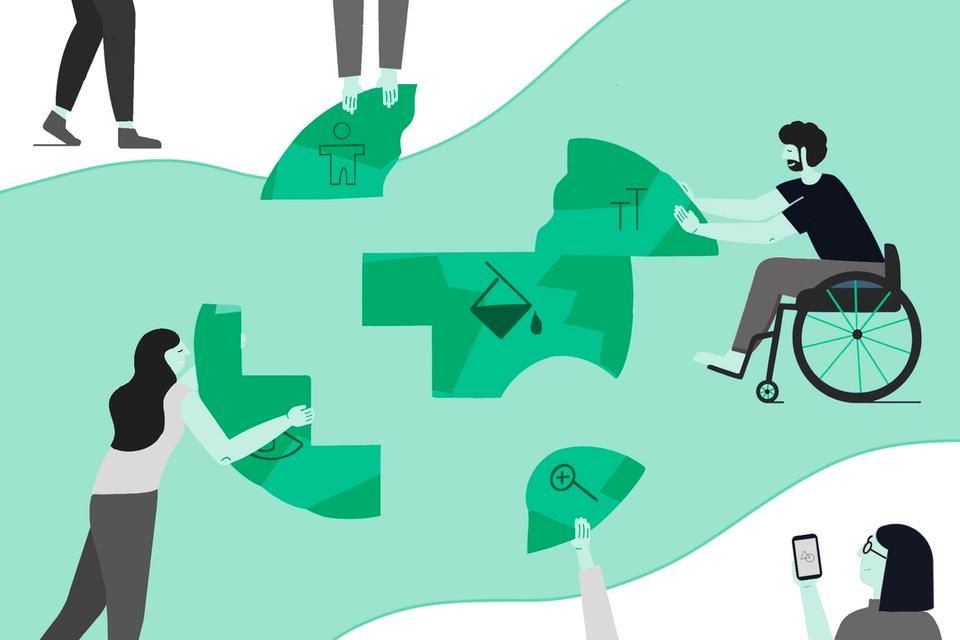
The Biggest Accessibility Barrier Isn't Disability - It's Design
Imagine arriving at a building with a beautiful entrance.
The doors are automatic.
The reception is welcoming.
Everything looks modern.
Then you notice there are only stairs.
For someone using a wheelchair, the building may as well have a locked front door.
Now imagine opening a mobile app.
The colours are attractive.
The animations are smooth.
The interface wins design awards.
But the buttons can't be read by a screen reader.
The text can't be enlarged.
Nothing can be navigated with a keyboard.
To someone who is blind, that "beautiful" app isn't usable.
The problem wasn't the person.
The problem was the design.
JOIN THE NDTS VOLUNTEER TEAM
If you are interested in contributing to the planning and delivery of Nigeria Disability Tech Summit 1.0, submit your Expression of Interest.
👉 JOIN THE NDTS VOLUNTEER TEAM
Submit your interest here:
https://forms.gle/cf3gxnSEwTmRFSWy9
Please note that this is an Expression of Interest. Submitting the form does not automatically guarantee selection. Applications will be reviewed based on the needs of the summit and the areas where volunteers can contribute most effectively.
Disability Does Not Create Most Barriers
This may sound surprising, but many barriers experienced by persons with disabilities are not caused by their disability.
They are created by environments that fail to consider different ways people interact with the world.
A staircase without a ramp.
A website without keyboard navigation.
A video without captions.
A PDF that can't be read by assistive technology.
A public announcement available only in audio.
A recruitment portal that times out before someone using assistive technology can complete an application.
These are design decisions.
And design decisions can be changed.
Accessibility Benefits Everyone
One of the biggest myths about accessibility is that it only helps persons with disabilities.
The reality is very different.
Think about captions on videos.
Originally introduced to support people who are deaf or hard of hearing, captions are now used by millions of people watching videos in noisy environments, learning a new language, or scrolling social media with the sound turned off.
Voice assistants are another example.
What began as an accessibility feature has become part of everyday life.
Automatic doors, curb cuts, text-to-speech, adjustable font sizes, dark mode, voice typing, predictive text, and simplified interfaces all demonstrate the same principle:
Designing for inclusion often improves the experience for everyone.
Good Design Removes Friction
Every unnecessary barrier creates friction.
A complicated interface.
Tiny buttons.
Poor colour contrast.
Confusing navigation.
Missing image descriptions.
Inaccessible forms.
These issues don't only affect persons with disabilities.
They frustrate older adults, first-time users, people with temporary injuries, people using slow internet connections, and even users carrying groceries while trying to unlock a door or operate a phone with one hand.
Inclusive design makes products easier to use for everyone.
Technology Gives Us an Opportunity
Today's designers and developers have access to better tools than ever before.
Artificial intelligence can generate captions in real time.
Screen readers have become more powerful.
Browsers include accessibility testing tools.
Design systems now include accessibility guidance.
Mobile operating systems provide built-in accessibility features.
The question is no longer whether accessible technology is possible.
The question is whether we choose to build it.
Accessibility Should Not Be an Afterthought
Too often, accessibility is considered at the end of a project.
A product launches.
Users encounter barriers.
Then accessibility becomes another item on a long list of updates.
That approach is expensive.
More importantly, it excludes people from the beginning.
Accessibility works best when it is part of the design process from day one.
It should influence how products are imagined—not just how they are fixed.
Every Profession Has a Role
Accessibility isn't only the responsibility of software developers.
Designers choose colours, typography, layouts, and interactions.
Product managers define priorities.
Engineers build the experience.
Architects shape physical spaces.
Educators create learning environments.
Healthcare professionals recommend technologies.
Government develops standards.
Businesses invest in innovation.
Researchers generate evidence.
Media influences public understanding.
Every decision either removes a barrier or creates one.
A Better Question
Instead of asking,
"Can people with disabilities adapt to our product?"
Perhaps we should ask,
"Have we designed our product so more people can use it?"
That small change in thinking can transform how we build technology, public services, workplaces, schools, and communities.
Building a More Inclusive Future
Accessibility is not about lowering standards.
It is about raising them.
It is about recognising that people experience the world differently and designing with those differences in mind.
Innovation reaches its full potential only when everyone has the opportunity to benefit from it.
The future of technology is not simply smarter.
It must also be more inclusive.
And that future begins with better design.
JOIN THE NDTS VOLUNTEER TEAM
If you are interested in contributing to the planning and delivery of Nigeria Disability Tech Summit 1.0, submit your Expression of Interest.
👉 JOIN THE NDTS VOLUNTEER TEAM
Submit your interest here:
https://forms.gle/cf3gxnSEwTmRFSWy9
Please note that this is an Expression of Interest. Submitting the form does not automatically guarantee selection. Applications will be reviewed based on the needs of the summit and the areas where volunteers can contribute most effectively.
Join the Conversation
The Nigeria Disability Tech Summit (NDTS) exists to bring together developers, designers, engineers, researchers, startups, policymakers, educators, disability advocates, assistive technology innovators, and persons with disabilities to explore how technology can remove barriers rather than create them.
Because accessibility isn't just a feature.
It's a mindset.
And together, we can build a future where technology works for everyone.